
Understanding Ring Circuit Intelligence: IET On-Site Guide Compliance in Shine Forms
.png)
Ring final circuits are one of the most common circuit types in UK electrical installations, but they come with specific requirements under BS 7671 Regulation 433.1.5. Shine Forms intelligence automatically validates your ring circuits against the IET On-Site Guide recommendations, ensuring your designs comply with regulations without manual calculations.
What Are Ring Final Circuits?
A ring final circuit is a wiring configuration where the live, neutral, and earth conductors form a complete loop, starting and ending at the same protective device. This design allows smaller cable sizes (typically 2.5mm²) to be protected by larger protective devices (30A or 32A) because current flows in both directions around the ring.
Under Regulation 433.1.5, if a cable can carry 20A in its installed conditions, then a 30A or 32A protective device combined with 2.5mm² (or 1.5mm² for MICC) cable is acceptable—provided the circuit is wired as a ring.
How Shine Forms Validates Ring Circuits
Shine Forms examines five key aspects to determine whether your ring final circuit design complies with BS 7671 and the IET On-Site Guide:
- Wiring type - Cable construction and insulation material
- Reference method - How the cable is installed (clipped direct, in conduit, etc.)
- Cable size - Cross-sectional area of conductors
- Protective device rating - Overcurrent protection characteristics
- Circuit designation - Whether it’s identified as a ring
Telling Shine Forms It’s a Ring Circuit
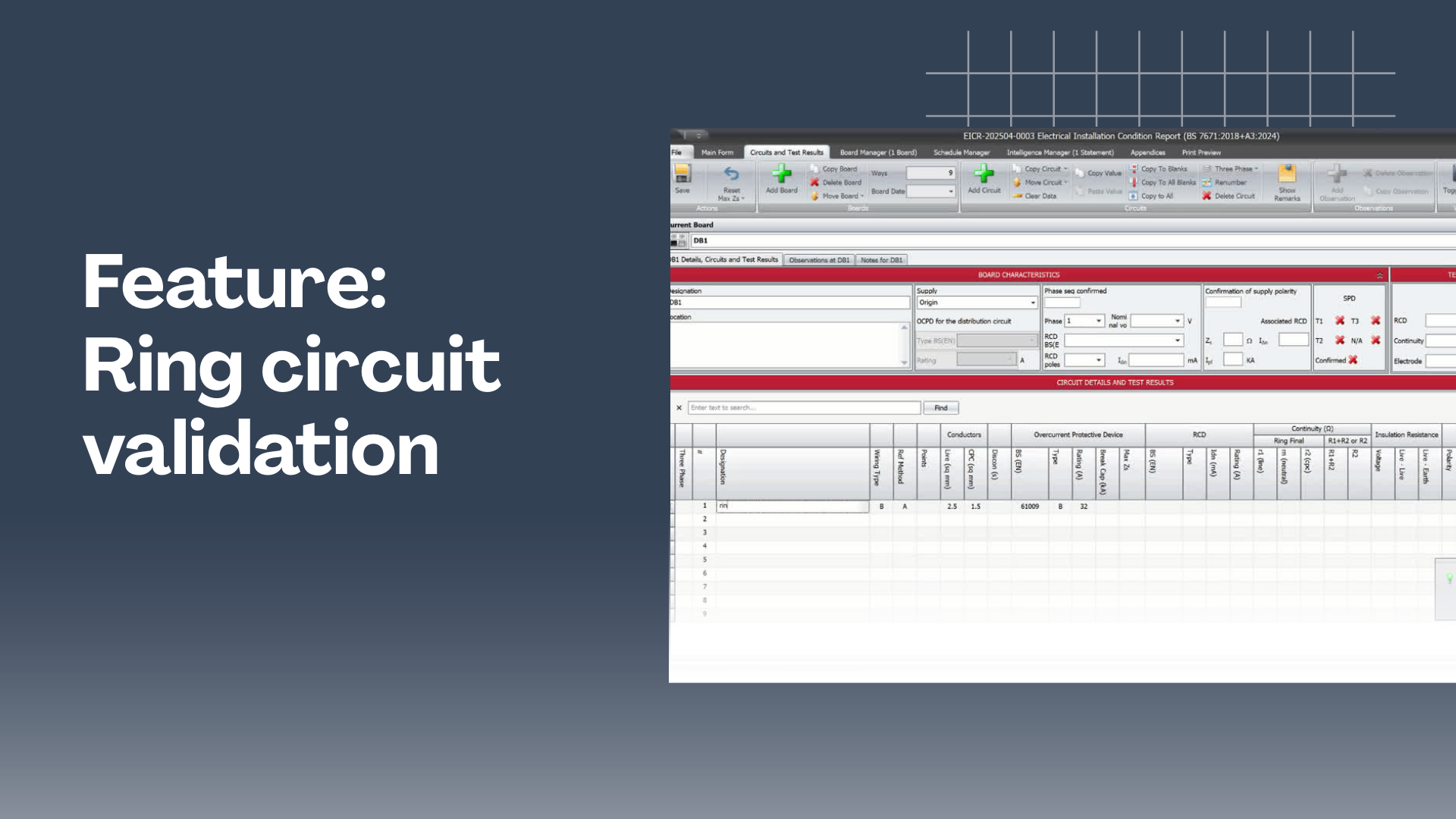
Simply enter the word “ring” in the circuit designation field. Shine Forms will recognise this and apply the ring final circuit validation rules.
Practical Example: The Classic 32A Ring
Let’s walk through the most common ring final circuit:
- Wiring type: A (PVC/PVC cables) or AF (flat twin and earth)
- Reference method: C (Clipped Direct) or 100/102 (enclosed in conduit/trunking)
- Cable size: 2.5mm² live, 1.5mm² CPC
- Protective device: 32A Type B MCB or RCBO
Without specifying “ring” in the designation, Shine Forms would flag this combination as non-compliant—2.5mm² cable wouldn’t normally be suitable for a 32A protective device.
But when you add “ring” to the designation:
Shine Forms recognises this as a valid ring final circuit per the On-Site Guide and reverts any intelligence warnings. The combination is compliant under Regulation 433.1.5 because:
- The cable can carry 20A (tabulated current-carrying capacity)
- It’s wired as a ring, so current flows both ways
- The 32A protective device is appropriate for this configuration
On-Site Guide Compliance Tables
Shine Forms incorporates Table 7.1(ii) from the IET On-Site Guide, which provides maximum circuit lengths for common ring and lighting circuit configurations.
Valid Ring Final Circuit Configurations
The most common valid ring finals for flat twin and earth cable (wiring type AF):
| Device Rating | Standard | Cable Size | CPC Size | Reference Methods | Max Length (TN-S + RCD) |
|---|---|---|---|---|---|
| 30A | BS 3036 | 2.5mm² | 1.5mm² | 100, 102, A, C | 106m |
| 32A | MCB/RCBO | 2.5mm² | 1.5mm² | 100, 102, A, C | 106m |
| 32A | BS 88-2 | 2.5mm² | 1.5mm² | 100, 102, A, C | 106m (voltage drop limited) |
These maximum lengths assume:
- TN-S earthing system
- 30mA RCD protection
- 230V supply voltage
- Ambient temperature of 30°C
- No de-rating factors
The Circuit Helper in Shine Forms displays these maximum lengths when you’re working on ring circuits, making it easy to verify compliance at a glance.
When Ring Circuits Aren’t Valid
Not all cable and device combinations work for ring finals. Shine Forms will warn you if:
Reference Method 101 or 103 (Table 4D5) The de-rating factor for insulation brings current-carrying capacity down to 17A and 13.5A respectively—below the 20A requirement for ring finals. Even upgrading to 4.0mm² only increases capacity to 17.5A for method 103.
Solution: Use clipped direct (Method C) or enclosed in conduit/trunking (Methods 100/102) instead, or design as a radial circuit.
Insufficient cable size If you try to use 1.5mm² cable for a 32A ring with certain installation methods, Pirform will flag it as non-compliant.
Solution: Upgrade to 2.5mm² cable or reduce protective device rating.
Working with the Circuit Helper
When you designate a circuit as a ring, the Circuit Helper displays helpful information directly in your circuit:
- Maximum circuit length - Calculated based on your specific configuration**
- Compliance status - Whether your design meets On-Site Guide recommendations
- Limiting factors - What constrains the circuit (voltage drop, Zs, adiabatic limit)
Click the Circuit Helper information icon to see detailed calculations and understand exactly why Shine Forms determined a specific maximum length.
Other Circuit Types: Lighting and Radials
Shine Forms On-Site Guide intelligence doesn’t stop at ring finals. It also validates:
Lighting Circuits
Common configurations like:
- 6A with 1mm² or 1.5mm² cable
- 10A with 1.5mm² cable
- 16A with 2.5mm² cable
Radial Final Circuits
Power circuits including:
- 16A radials with 2.5mm² cable
- 20A radials with 2.5mm² or 4mm² cable
- 32A radials with 4mm², 6mm², or 10mm² cable
Each circuit type has specific maximum lengths based on protective device type, earthing system, and RCD protection.
Understanding the Limiting Factors
The maximum circuit length for any configuration is constrained by one or more factors:
Voltage Drop (vd)
The circuit length where voltage drop exceeds 3% of supply voltage (typically 6.9V for 230V systems).
Earth Fault Loop Impedance (zs)
The circuit length where earth fault loop impedance exceeds the maximum Zs for the protective device to disconnect within the required time.
Adiabatic Limit (ad)
The circuit length where the cable’s ability to withstand fault current without damage is exceeded.
Line to Neutral (sc)
The circuit length where line-to-neutral fault conditions affect compliance.
Shine Forms shows which factor is limiting your circuit in the Circuit Helper and Intelligence Manager, helping you understand design constraints.
Common Scenarios
Scenario 1: Standard Kitchen Ring
Configuration: 32A MCB, 2.5mm² cable, reference method C (clipped direct)
Simply type “ring” in the circuit designation. Shine Forms confirms compliance and shows maximum length of 106m for TN-S with RCD protection.
Scenario 2: Garage Ring on Different Installation Method
Configuration: 32A MCB, 2.5mm² cable, reference method 101 (surrounded by thermal insulation on one side)
Shine Forms warns this isn’t valid for a ring circuit—the de-rated current capacity is only 17A, below the 20A requirement.
Solution: Use 4mm² cable, change installation method, or design as a radial circuit instead.
Scenario 3: Existing Installation with 4mm² Cable
Configuration: 32A MCB, 4mm² cable, reference method C
Type “ring” in the designation. Pirform confirms compliance and shows increased maximum length of 171m due to the larger cable.
Integration with Pirform’s Intelligence System
Ring circuit validation is part of Shine Forms broader Intelligence system, which means:
Automatic Validation
As soon as you type “ring” in the circuit designation, Shine Forms:
- Checks your configuration against On-Site Guide tables
- Calculates maximum circuit length
- Reverts any previous cable sizing warnings if the ring is valid
- Adds warnings if the configuration isn’t suitable for a ring
Intelligence Manager Visibility
All ring circuit intelligence appears in the Intelligence Manager where you can:
- See exactly what Pirform checked
- Review the specific table or regulation referenced
- Suppress intelligence if your professional judgment differs
- Navigate directly to the circuit in question
Cascading Updates
If you change any parameter (cable size, protective device, installation method), Shine Forms automatically:
- Recalculates ring circuit compliance
- Updates maximum circuit length
- Reverts or adds intelligence as appropriate
- Keeps all related fields synchronized
Best Practices
Always Specify “Ring” in the Designation
Don’t rely on Pirform to guess whether a circuit is a ring. Explicitly identify rings by including “ring” in the circuit designation field.
Check Maximum Circuit Length
Even if Shine Forms confirms compliance, verify your actual circuit length doesn’t exceed the calculated maximum. The Circuit Helper makes this easy.
Review Installation Method Carefully
The reference method significantly affects current-carrying capacity. Methods 101 and 103 often make ring circuits non-viable.
Consider Radials for Long Runs
If your circuit exceeds the maximum ring length, consider designing it as a radial with appropriately sized cable and protective device.
Use the Circuit Helper
Keep the Circuit Helper expanded when entering circuit details. Real-time feedback helps you make informed design decisions before completing the certificate.
Glossary of Terms
Reference Methods - Installation methods from BS 7671 Appendix 4:
- Method A/C: Clipped direct to surface or structure
- Method 100: Enclosed in conduit in a thermally insulated wall
- Method 101: Enclosed in conduit in a thermally insulated wall, touching one side
- Method 102: Enclosed in conduit on a wooden or masonry wall
- Method 103: Enclosed in conduit in a thermally insulated wall, touching both sides
Protective Device Standards:
- BS 3036: Rewireable fuses (semi-enclosed)
- BS 88-2 / BS EN 60269-2: Cartridge fuses
- BS 88-3: Cartridge fuses for household use
- MCB: Miniature circuit breaker (Type B/C/D)
- RCBO: Residual current circuit breaker with overcurrent protection
Wiring Types:
- Type A: PVC insulated, PVC sheathed cables
- Type AF: Flat twin and earth cables (most common in domestic installations)
Learn More
Want to dive deeper into related Pirform features?
- How Shine Forms Intelligence Saves Time - Complete guide to the intelligence system
- Introducing Circuit Helper - Visual circuit intelligence
- On-Site Guide Intelligence Documentation - Complete technical tables and references
- Boards and Circuits Guide - Working with circuits in Pirform
Questions About Ring Circuits?
Ring final circuit design can be complex, especially when dealing with unusual installation methods or longer cable runs. If you have questions about how Pirform validates your specific configuration, our support team is here to help.
Contact us at support@shineforms.co.uk or consult our comprehensive documentation at docs.shineforms.co.uk.