
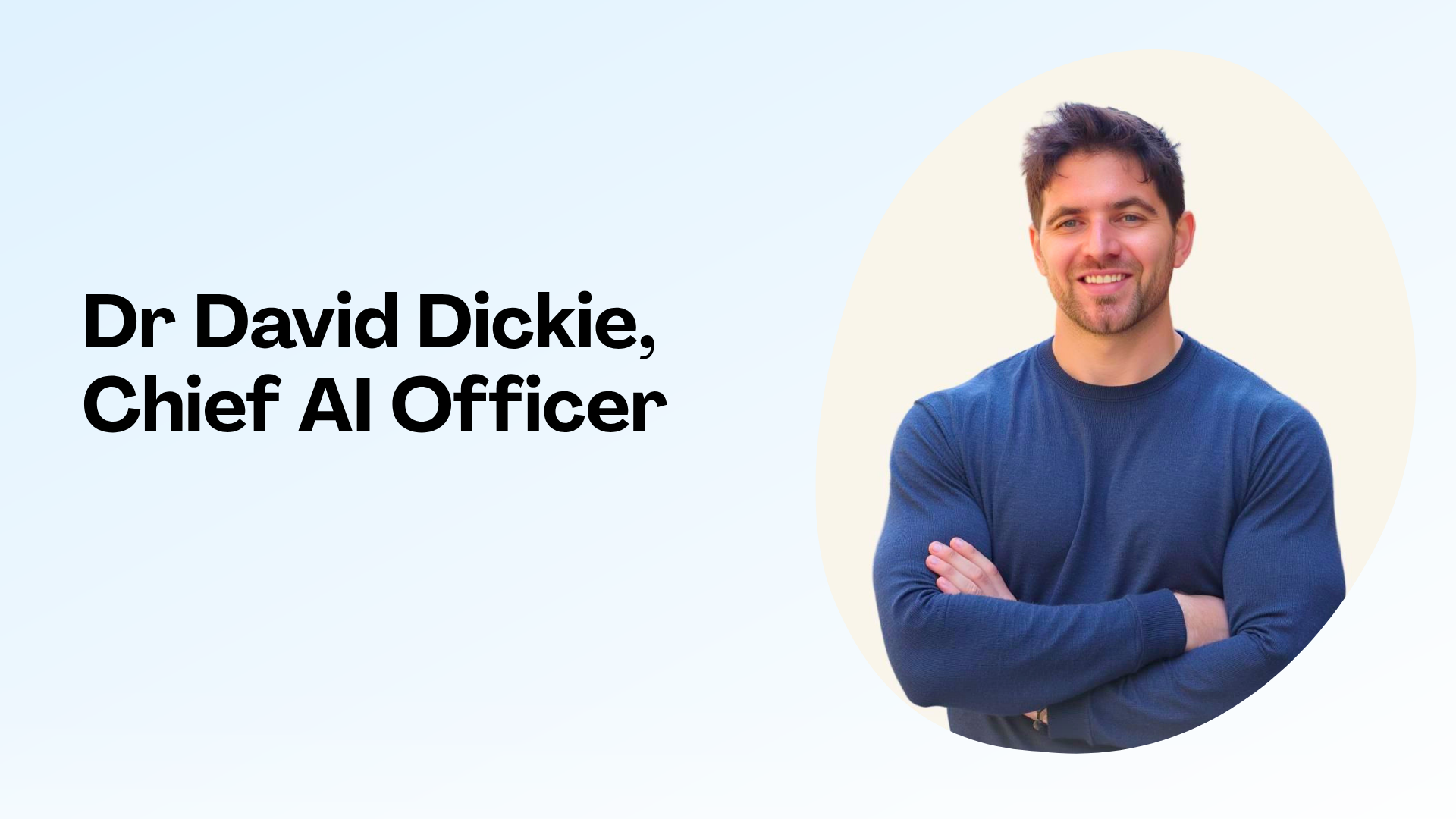
Meet Dr David Dickie, our Chief AI Officer
Meet Dr David Dickie, our Chief AI Officer
Dr David Dickie has spent nearly 20 years in AI research and development. His background spans industrial engineering, financial services, and, most recently, healthcare - building AI that analyses brain scans, detects neurodegeneration, and helps clinicians make better decisions. The kind of work where being wrong has serious consequences.
He’s now joined Shine Forms as Chief AI Officer. We asked him the questions we think every electrician and Qualified Supervisor (QS) should be putting to their certification software company right now.
You’ve been in AI for almost 20 years. What do you make of the current noise around it?
Lots of people think of ChatGPT when they hear AI. But ChatGPT, and other chatbots like it, are only one part of AI - a very visible part, but still just one part. There’s a whole spectrum of AI techniques beyond chatbots and other generative AI tools, and the right one depends entirely on the problem you’re trying to solve. Right now, a lot of companies are doing it backwards. They’ve decided they need a chatbot and are desperately looking for somewhere to put it.
Several certification software companies are already rolling out AI features like ChatGPT. What’s your view?
There’s a significant risk there. ChatGPT has a well-documented habit of making things up. It produces confident-sounding answers that can be completely wrong, often referred to as “hallucinations”. But these are nothing like how humans hallucinate, they’re just statistical quirks that come from how large language models like ChatGPT are built.. You cannot roll that out into a safety-critical environment without serious guardrails in place.
There’s also a very recent study on programmers using large language models for coding, which I think about a lot. They estimated they were getting efficiency gains of 40% - 50% from the models. But when researchers actually measured what was happening, they were taking longer and making more mistakes. And 95% of generative AI initiatives in large enterprises have so far delivered zero return. I’d expect some of those certification software companies to land in that bucket.
What should electricians and QSs be asking when a software company says it uses AI?
Ask where the regulation knowledge comes from and what type of AI they are using specifically. If it’s generative AI that “learned” regulation knowledge from the internet, you’re dealing with a model that averages across whatever it found online. Forum posts, outdated PDFs, old edition interpretations. The model doesn’t know what it doesn’t know, and when it doesn’t know something, it doesn’t tell you. It just produces something that sounds plausible (those “hallucinations” that we spoke about before).
Me and my wife have a Border Terrier. Scruffy wee thing. When Google makes those little memory videos from your photos, it kept grouping the dog with the cats. Its ‘learning’ model had never seen a Border Terrier that small before, so it filed her under cat. Funny when it’s a dog. Not funny when an engineer photographs a circuit configuration the model has never seen before. It won’t say it doesn’t know. It’ll give you something. And the engineer might not know it’s wrong.
Where does AI fit at Shine Forms?
Shine Forms already has something most companies don’t - regulation knowledge verified directly against BS 7671 by someone who helps write it. That’s a strong foundation. We won’t be dropping a generative model on top of that and hoping for the best.
We start with the problem, not the solution. There are things broader types of AI that people don’t commonly think about can do here that would help - prioritising inspection jobs by risk, finding subgroup of tasks that can be done together to save time. But none of that gets rolled out until we’re confident it’s doing what we intend it to do.
What does your involvement look like day to day?
Day one is understanding the roadmap and the problems Sean and Gary are hearing from customers. Then it’s our job to work out whether AI can solve any of those problems, what type of AI that is (if any), and how long it would take to do it properly.
We don’t come in with a fixed solution. We come in with questions.
Sean and Gary know this product and this industry. I know AI. That’s the combination.
Last question. Glasgow or Edinburgh?
Glasgow. All day long. Edinburgh is lovely if you like things that look like Harry Potter and castles at the top of hills.
Dr David Dickie is Chief AI Officer at Shine Forms. He has built AI functions at some of the world’s largest organisations, holds a PhD from the University of Edinburgh and lives in Glasgow. He has over 4000 citations across 100+ published research papers.